
There are an estimated 21 million CCTV cameras operating across the UK — and the vast majority of them are privately owned. Home CCTV has never been more popular or more affordable, and for good reason: it works. But there’s a question I get asked surprisingly often when I’m out doing surveys, and it’s one that a lot of homeowners have never properly considered.
Is my CCTV system actually legal?
The short answer is: probably yes — but it depends almost entirely on where your cameras are pointing. Get this wrong, and you can find yourself on the wrong side of UK data protection law, facing complaints from neighbours, and — in theory — enforcement action from the Information Commissioner’s Office (ICO).
In this guide, I’ll walk you through exactly what the law says, where the boundaries are, and what you can do to make sure your system is fully compliant.
The Good News: The Domestic Purposes Exemption
Let’s start with the reassuring part. Under Article 2(2)(a) of the UK GDPR, CCTV used for “purely personal or household activity” is exempt from data protection legislation. In plain English: if your cameras only cover your own private property — your front door, driveway, back garden — you are not required to register as a data controller, display signage, carry out data protection impact assessments, or comply with any of the formal obligations that apply to businesses.
This is the situation most homeowners are in, and it’s perfectly straightforward. You’re securing your home, your cameras stay within your boundaries, and the law leaves you alone.
Where It Gets Complicated: The Boundary Problem
Here’s where many homeowners run into trouble without realising it.
The moment your camera captures footage beyond the boundary of your private property — a neighbour’s driveway, a shared passageway, the pavement outside your house — the domestic exemption no longer applies. At that point, UK GDPR and the Data Protection Act 2018 kick in, and you become what’s known as a data controller — with all the legal responsibilities that brings.
Those responsibilities include:
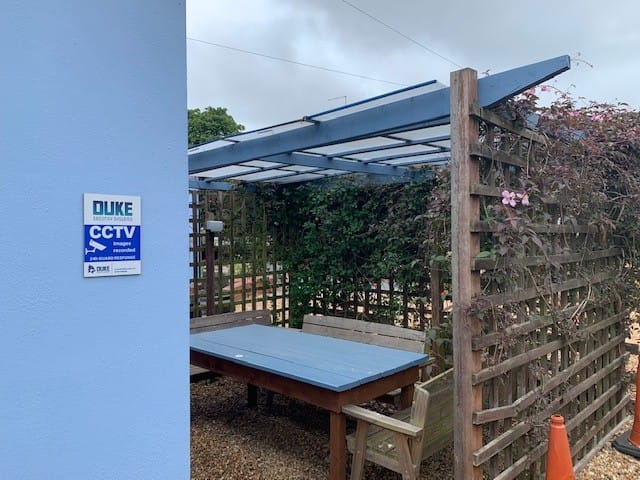
- ✅ Displaying clear signage informing people that they are being recorded
- ✅ Having a documented data retention policy — specifying how long footage is kept and how it’s deleted
- ✅ Responding to subject access requests — if a neighbour asks to see footage they appear in, you’re legally obliged to provide it
- ✅ Considering a Data Protection Impact Assessment (DPIA) if the recording is extensive or particularly intrusive
- ✅ Being able to justify your use of the cameras — there must be a legitimate reason proportionate to what you’re recording
This catches a lot of homeowners off guard. A wide-angle camera installed to cover a front driveway will almost always capture some pavement. A camera covering the side of a house may pick up a neighbour’s path. In these cases, even if the coverage is incidental, the exemption is technically lost.
Smart Doorbells: A Special Case
Ring doorbells, Nest cameras, and similar devices have become one of the most common sources of neighbour disputes in the UK — and it’s easy to see why. A doorbell camera positioned at head height near a shared boundary will almost inevitably capture footage of whoever walks past, not just visitors approaching your door.
The ICO’s guidance is clear: the same rules apply to smart doorbells as to traditional CCTV cameras. If the footage captured goes beyond your private property, data protection law applies. The fact that it’s a doorbell rather than a dedicated CCTV camera makes no difference in law.
One additional consideration with smart doorbells: footage is often stored in the cloud by the manufacturer — sometimes on servers outside the UK. This raises further data protection questions that most homeowners won’t have considered when they clicked “buy” on Amazon.
Can My Neighbour Complain?
Yes — and they have a formal route to do so. The ICO has a specific complaints process for home CCTV disputes, and neighbours who believe they are being filmed without justification can submit a complaint directly.
In practice, the ICO rarely takes formal enforcement action against individual homeowners — the guidance acknowledges it would be disproportionate in most cases. However, a complaint can still create significant stress, require you to provide written explanations and documentation, and in more serious cases, escalate to harassment proceedings under the Protection from Harassment Act 1997.
Neighbours also have the right to submit a subject access request (SAR) — formally asking you to provide any footage that features them. If your cameras capture their property and you receive a SAR, you are legally required to respond within one month.
The simplest way to avoid all of this is to position cameras correctly in the first place.
What About Publishing Footage Online?
This is a common mistake, and one worth flagging specifically. Posting CCTV footage online — whether to a neighbourhood Facebook group, YouTube, TikTok, or anywhere else — immediately removes you from the domestic exemption, regardless of whether the footage only shows your own property. The moment footage enters the public domain, it becomes subject to UK GDPR in full.
I’d always recommend against publishing footage unless you’ve taken legal advice first, or you’ve had it reviewed by police in the context of an ongoing investigation.
How to Make Sure Your System Is Compliant
Here’s what I recommend to every homeowner I survey:
- ✅ Aim cameras inward — cover your doors, windows, and driveway, but position cameras to minimise capture of public spaces and neighbouring properties
- ✅ Use privacy masking — most modern systems, including the Hikvision range we install at Duke, allow you to digitally block out specific areas of the camera’s field of view. If a camera inevitably catches a corner of next door’s drive, a privacy mask removes that area from the recording entirely
- ✅ Choose the right lens and angle — a professional installer can select the right camera and field of view for each location, rather than using a wide-angle camera that captures far more than intended
- ✅ Keep footage for a reasonable period only — 30 days is the standard recommendation for residential systems. There’s no need to retain footage indefinitely
- ✅ Don’t share footage publicly unless you’re working with the police on a specific incident
Do I Need to Register My CCTV?
If your cameras remain within your private property and the domestic exemption applies, no — you do not need to register with the ICO. There is no licensing requirement for residential CCTV in the UK, and no obligation to inform your local council or police that a system is in place (though registering with your local Neighbourhood Watch or police community scheme can be a good idea for practical purposes).
If your cameras do capture public or neighbouring spaces and you fall outside the domestic exemption, you may need to register as a data controller — though this depends on the extent of the coverage and the specific circumstances. If you’re unsure, the ICO’s home CCTV guidance is a good starting point, or speak to a professional installer who can advise on positioning.
The Bottom Line
For the vast majority of homeowners, a properly installed and positioned CCTV system is entirely legal and requires no formal registration or compliance process. The key is making sure cameras are aimed at your own property, not your neighbours’ or the public street — and that footage isn’t shared publicly without good reason.
Where homeowners run into problems is usually with positioning: cameras installed without professional advice that capture more than intended, creating neighbour disputes that could easily have been avoided.
When I carry out a survey, one of the things I assess is exactly where each camera should be positioned to give you the best possible coverage of your own property while keeping you on the right side of the law. If you’d like us to take a look at your home and give you an honest recommendation, book a free, no-obligation survey with us.
📞 01733 639096
🔗 Book your free home security survey here
Duke Security Systems install Hikvision CCTV and wireless intruder alarm systems across Peterborough, Stamford, Market Deeping, and the surrounding area. All installations are carried out to professional standards with full compliance guidance included.